What Are the Best Promotional Products for Lead Generation? A Buyer’s Guide
The best promotional products for lead generation are tech accessories, premium notebooks, insulated drinkware, and eco-friendly tote bags — items that recipients use daily in professional settings, keeping your brand visible throughout the sales cycle. PPAI research shows these categories generate 3–5x more qualified leads than traditional marketing methods, with an average cost-per-impression of less than one cent.
Below, we break down the top-performing product categories, how to match products to your target audience, and how to measure the actual pipeline impact so you can make a data-backed investment in your next campaign.
Why do promotional products work for lead generation?
Promotional products work for lead generation because they create a tangible, physical brand experience that digital marketing cannot replicate — and that tangible connection drives measurably higher engagement. ASI research shows that promotional products generate a cost-per-impression of $0.007, compared to $0.019 for digital advertising, while producing significantly stronger brand recall among B2B decision-makers.
The psychology is straightforward. When a prospect receives a useful branded item, the reciprocity principle kicks in — they feel a natural inclination to engage with your company in return. PPAI data shows that 83% of trade show attendees remember the company that gave them a promotional item, and recipients demonstrate 65% higher purchase intent than prospects who weren’t offered anything.
The compounding advantage is time. A digital ad impression lasts seconds. A quality branded tumbler or notebook sits on a prospect’s desk for months, generating 15–20 impressions per day without any additional spend. Companies that integrate promotional products into their lead generation strategies consistently report shorter sales cycles and higher conversion rates compared to digital-only approaches.
What are the top promotional products for B2B leads?
The top promotional products for B2B lead generation are tech accessories, premium notebooks, insulated drinkware, eco-friendly tote bags, and Bluetooth speakers. These five categories consistently deliver the highest lead quality and strongest ROI based on industry conversion tracking data, because they combine high perceived value with daily professional use.
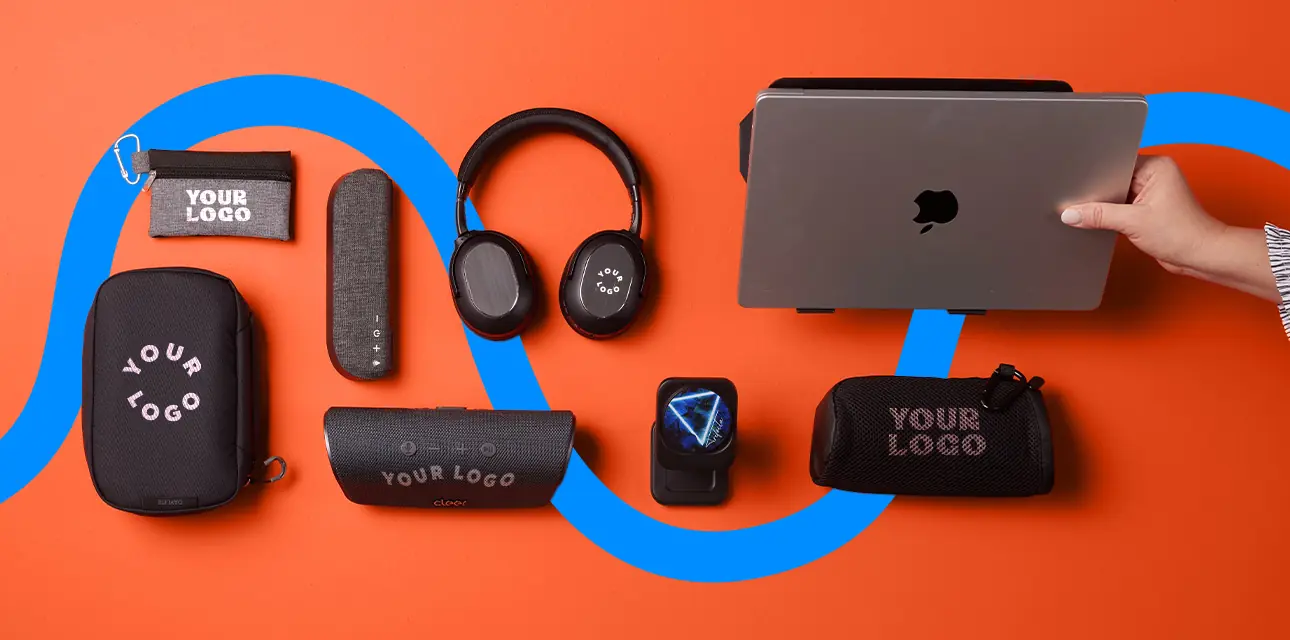
Wireless charging pads, USB-C drives, and portable power banks ($8–25/unit): Tech accessories generate 89% brand recall and correlate with the highest lead-to-opportunity conversion rates. They signal innovation and match the digital-first environment of modern business.Premium notebooks and journals ($5–15/unit): Moleskine-style notebooks appeal directly to executives and decision-makers. Industry research shows over 70% of C-suite professionals use branded notebooks from conferences, providing months of daily desk-level visibility.Insulated stainless steel drinkware ($12–30/unit): Premium tumblers and water bottles deliver exceptional longevity — recipients keep them 12+ months and generate an average of 1,400 brand impressions over their lifetime.Eco-friendly tote bags ($6–18/unit): Sustainable materials like recycled cotton resonate with environmentally conscious B2B buyers. PPAI research indicates that 68% of business professionals prefer brands demonstrating environmental responsibility.Bluetooth speakers ($15–40/unit): Compact speakers provide premium positioning for complex sales cycles. Industry data shows audio devices correlate with higher average deal sizes, making them ideal for enterprise-level prospecting.
When selecting products, prioritize items that match your prospect’s professional environment. Explore StaplesPromo’s full promotional products collection to compare options across all five categories with transparent bulk pricing.
How do you choose the right promotional products for your target audience?
Choose promotional products by matching item type and price point to your buyer persona’s job role, industry, and deal size. PPAI’s Audience Alignment research shows that targeted product selection generates 76% higher engagement rates than choosing generic items for broad distribution.
The most important variable is practical utility. Products that recipients use weekly or daily generate over 8x more leads than decorative items that sit in a drawer. Start by mapping your buyer’s daily workflow — do they commute with coffee, take notes in meetings, or travel with devices that need charging? That’s where your branded product should show up.
Price point should track to deal size. The general rule is to spend 0.5–1.5% of your average contract value on the promotional item. Enterprise targets ($100K+ deals) justify premium gifts in the $25–50 range, while SMB leads call for practical items in the $8–15 range. ASI’s Brand Perception research confirms that 84% of prospects judge company credibility based on the quality of promotional products they receive — so going too cheap can actually hurt your pipeline.
A/B test different product categories at similar events to find what resonates with your specific audience. Track not just acceptance rates but downstream metrics like meeting bookings and opportunity creation to refine your approach over time.
How do you measure ROI on promotional products for lead generation?
Measure promotional product ROI by tracking cost per lead, lead-to-opportunity conversion rate, and cost per acquisition against your other marketing channels. Industry benchmarks show that promotional product leads cost $35–75 per qualified lead, compared to $85–150 for digital advertising leads, while converting at nearly double the rate of cold outreach.
The four metrics that matter most are cost per lead (total investment divided by qualified leads), lead-to-opportunity conversion rate (PPAI data shows 28% average for promotional product leads versus 16% for cold outreach), cost per acquisition (industry benchmarks show 23% lower CPA than other channels), and brand recall (85% unaided recall among recipients at 30–60 days post-distribution).
The measurement gap most companies miss is attribution. Assign unique tracking codes to every promotional campaign — QR codes on the item itself, personalized URLs, or NFC tags. Companies using multi-touch attribution for promotional products consistently demonstrate nearly 3x higher program ROI than those relying on last-touch models. Your CRM should tag every lead sourced through a promotional product campaign so you can track pipeline impact through to closed revenue.
How should you distribute promotional products at trade shows?
Distribute promotional products at trade shows by qualifying prospects before giving away items, tiering your products by lead quality, and following up within 48 hours referencing the specific item. PPAI’s Trade Show research found that companies using intentional distribution strategies generate over 3x more qualified leads than those handing out products indiscriminately.
The biggest ROI lever is tiered distribution. Offer basic items ($3–8) for initial conversations, mid-tier items ($15–30) for qualified prospects who answer your discovery questions, and executive gifts ($40–75) for confirmed decision-maker meetings. Industry analysis shows this approach improves conversion rates by over 40% compared to one-size-fits-all distribution.
Personalization amplifies impact. On-site customization — adding a recipient’s name or company logo — drives dramatically higher retention rates. Bundle every item with a QR code linking to a relevant resource (case study, ROI calculator, or product demo) to bridge the physical-digital gap. Research shows bundled approaches increase content engagement by 76%.
One tactic that consistently outperforms expectations: ship premium items post-event rather than distributing on-site. This reduces booth logistics, enables more personalization, and creates a second touchpoint that reinforces your brand. Trade show studies show post-event shipping strategies increase meeting conversion rates by 38% while reducing per-lead costs.
Conclusion
Promotional products remain one of the most cost-effective lead generation tools available to B2B companies — delivering lower cost per lead, higher conversion rates, and stronger brand recall than digital-only approaches. The key is selecting products that match your buyer’s daily routine, distributing them strategically, and measuring pipeline impact with proper attribution.
Whether you’re building a trade show strategy, launching an ABM campaign, or looking for client appreciation gifts that open doors, the right promotional products turn cold prospects into warm conversations. Explore StaplesPromo’s full catalog of promotional products for lead generation — with bulk pricing, fast turnaround, and expert customization support to match any campaign goal.

